Chronologie aller Bände (1 - 6)
Die Reihenfolge beginnt mit dem Buch "Agent Based Modelling of Urban Systems". Wer alle Bücher der Reihe nach lesen möchte, sollte mit diesem Band von Mohammad-Reza Namazi-Rad beginnen. Der zweite Teil der Reihe "Prolog: The Next 50 Years" ist am 16.06.2023 erschienen. Mit insgesamt 6 Bänden wurde die Reihe über einen Zeitraum von ungefähr 10 Jahren fortgesetzt. Der neueste Band trägt den Titel "Rough Sets".
- Anzahl der Bewertungen für die gesamte Reihe: 0
- Ø Bewertung der Reihe: 0
- Start der Reihe: 11.01.2017
- Neueste Folge: 05.09.2026
Diese Reihenfolge enthält 6 unterschiedliche Autoren.
- Autor: Namazi-Rad, Mohammad-Reza
- Anzahl Bewertungen: 0
- Ø Bewertung:
- Medium: Buch
- Veröffentlicht: 11.01.2017
- Genre: Sonstiges
Agent Based Modelling of Urban Systems
This book constitutes revised, selected, and invited papers from the First International Workshop on Agent Based Modelling of Urban Systems, ABMUS 2016, held in conjunction with AAMAS 2016 in Singapore in May 2016.
The 11 papers presented in this volume were carefully reviewed and selected from 20 submissions. They were organized in topical sections named: urban systems modeling; traffic simulation in urban modeling; and applications.
- Autor: Koch, Fernando
- Anzahl Bewertungen: 0
- Ø Bewertung:
- Medium: Buch
- Veröffentlicht: 21.02.2019
- Genre: Sonstiges
Artificial Intelligence in Health
The 18 revised full papers included in this volume were carefully selected from the 26 papers accepted for presentation out of 42 initial submissions. The papers present AI technologies with medical applications and are organized in three tracks: agents in healthcare; data science and decision systems in medicine; and knowledge management in healthcare.
- Autor: Warren, David S.
- Anzahl Bewertungen: 0
- Ø Bewertung:
- Medium: E-Book
- Veröffentlicht: 16.06.2023
- Genre: Sonstiges
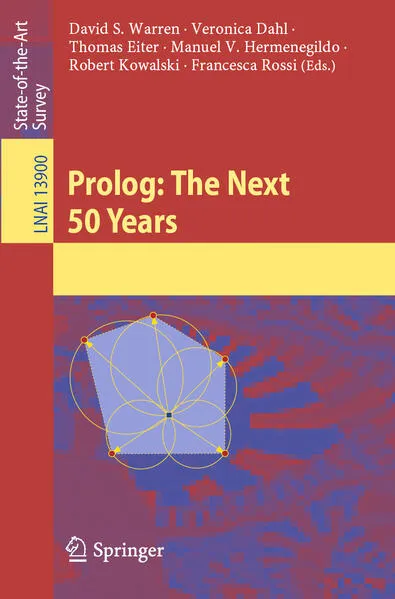
Prolog: The Next 50 Years
After a first chapter that gently introduces the Prolog programming language using examples, the next 7 papers discuss general views of the language, possible extensions for the future, and how Prolog can generally be used to solve problems; the next 5 papers explore ideas and experiences of teaching Prolog programming and then 2 papers discuss technology that has been developed for help in that teaching; the next 3 papers describe new languages based on Prolog which show future directions for logic programming; the next 5 chapters explain the applications that were the finalists for the 2022 Alain Colmerauer Prize; and the final 8 papers describe applications developed using the Prolog language, demonstrating the language’s range.
- Autor: Ronzhin, Andrey
- Anzahl Bewertungen: 0
- Ø Bewertung:
- Medium: Buch
- Veröffentlicht: 05.09.2023
- Genre: Roman
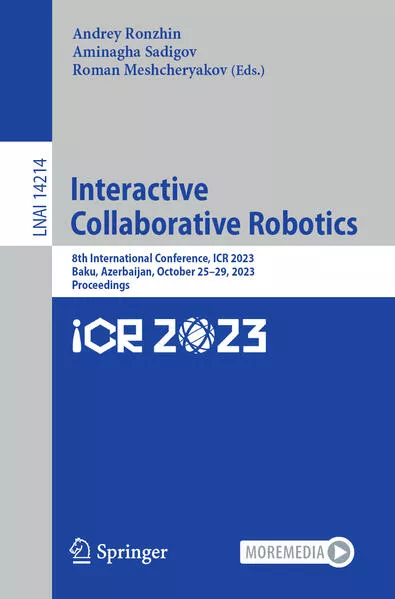
Interactive Collaborative Robotics
The 33 full papers included in this book were carefully reviewed and selected from 56 submissions. They were organized in topical sections as follows: focused the foundations and means of collaborative behavior of one or more robots physically interacting with hu-mans in operational environments configured with embedded sensor networks and cloud services under uncertainty and environmental variability.
- Autor: Alonso-Betanzos, Amparo
- Anzahl Bewertungen: 0
- Ø Bewertung:
- Medium: Buch
- Veröffentlicht: 12.06.2024
- Genre: Sonstiges
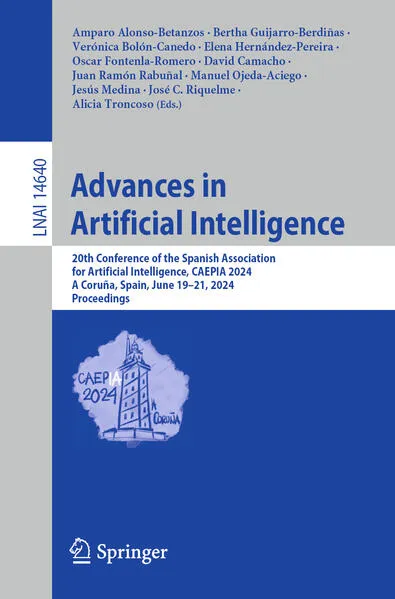
Advances in Artificial Intelligence
This book constitutes the refereed proceedings of the 20th Conference of the Spanish Association for Artificial Intelligence, CAEPIA 2024, held in A Coruña, Spain, during June 19–21, 2024.
The 27 full papers presented in this book were carefully reviewed and selected from 38 submissions.
CAEPIA is a forum open to researchers from all over the world to present and discuss their latest scientific and technological advances in Artificial Intelligence (AI).
The papers cover such themes as: machine learning, search and optimization, creativity and AI, ontologies and knowledge graphs, education and AI, foundation, models and applications of AI, uncertainty in AI, ambient intelligence and smart environments, explainable and responsible AI, fuzzy logic, natural language processing, knowledge representation, reasoning and logic, constraints, search and planning, multi-agent systems, computer vision and robotics, and intelligent web and information retrieval.

- Autor: Aragón, Roberto G.
- Anzahl Bewertungen: 0
- Ø Bewertung:
- Medium: Buch
- Veröffentlicht: 05.09.2026
- Genre: Sonstiges
Rough Sets
This LNCS volume constitutes the proceedings of the International Joint Conference on Rough Sets, IJCRS 2026, held in Cádiz, Spain, during May 2026.
The 27 full papers included in this book were carefully reviewed and selected from 106 submissions. These papers focus on following topical sections: Foundations and Models of Rough Sets; Computational Intelligence and Three-Way Decision.