Chronologie aller Bände (1 - 2)
Die Reihenfolge beginnt mit dem Buch "Linguistische Berichte Heft 278". Wer alle Bücher der Reihe nach lesen möchte, sollte mit diesem Band von Markus Steinbach beginnen. Die Reihe umfasst derzeit 2 Bände. Der neueste Band trägt den Titel "Linguistische Berichte Heft 281".
- Anzahl der Bewertungen für die gesamte Reihe: 0
- Ø Bewertung der Reihe: 0
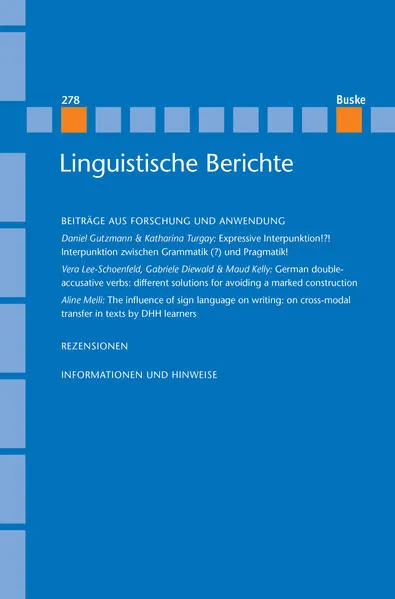
- Band: 278
- Autor: Steinbach, Markus
- Anzahl Bewertungen: 0
- Ø Bewertung:
- Medium: Buch
- Veröffentlicht: 16.05.2024
- Genre: Sonstiges
Linguistische Berichte Heft 278
Beiträge aus Forschung und Anwendung
– Daniel Gutzmann & Katharina Turgay: Expressive Interpunktion!?! Interpunktion zwischen Grammatik (?) und Pragmatik!
Abstract: Whereas the use of most punctuation marks is thought to be governed by grammatical rules, some punctuation marks can be used in a more expressive way that rather reflects emotions and/or attitudes of the writer instead of grammatical properties. In this paper, we will discuss the distinction between grammatical and expressive punctuation and suggest that pragmatic punctuation marks exhibit certain features that the more grammatical punctuation marks do not: They are expressive, they can occur rather freely inside a sentence, they can be repeated to intensify their effect, and they can be combined with other expressive punctuation. A comparison of commas and exclamation points illustrates the difference between grammatical and pragmatic punctuation marks. We will investigate the most common punctuation marks with respect to these properties and assign them a place in what may be called the grammar-pragmatics continuum of punctuation. We will conclude with a comparison between expressive punctuation and emojis which can be used to fulfill similar roles and present a case study of the combination „!?!“.
– Vera Lee-Schoenfeld, Gabriele Diewald & Maud Kelly: German double-accusative verbs: different solutions for avoiding a marked construction.
Abstract: Extending Lee-Schoenfeld & Diewald’s (2017) corpus investigation and formal analysis of ‘lehren’ (‘teach’) to the other four German double-accusative verbs, ‘abfragen’, ‘abhören’ (both meaning ‘quiz/test’), ‘kosten’ (‘cost’), and ‘fragen’ (‘ask’), we show that each verb follows its own individual path to overriding the highly marked ACC > ACC pattern, with the latest usage data revealing notably different results as to the verbs’ most typical syntactic patterns, meaning variants, and contextual features. Specifically, we propose that this small group of verbs makes use of three different “strategies” for avoiding the ACC > ACC pattern: (i) change of major valency frame from a ditransitive to a monotransitive pattern (‘abhören’ and ‘abfragen’), (ii) limiting the second object to primarily a clausal or prepositional one (‘fragen’), and (iii) semantic diversification / polysemy combined with different preferences as to the valency pattern per meaning (‘kosten’). We back up these claims by comparing the usage patterns of the verbs in four time periods between 1800 and 2010 via corpus analyses using DWDS (Digitales Wörterbuch der deutschen Sprache, https://www.dwds.de/). We also present the results of a synchronic search using the German web corpus deTenTen.
– Aline Meili: The influence of sign language on writing: on cross-modal transfer in texts by DHH learners.
Abstract: Literacy is an important competence not only in a scholarly setting, but also for actively taking part in a literate society. For deaf users of a sign language, however, the ‘written word’ is challenging for the following two reasons. First, signers of a face-to-face, unwritten visual language need to transfer their message into a written modality. Second, as there is no widely accepted standardized written form for signed languages, the code which they must use is that of the written representation of an oral language, which is often a second language (L2) to users of a sign language. The study reported here addresses these challenges with written German data collected from Swiss German Sign Language (DSGS) deaf signers. The variations found in these written German texts are the result not only of second language acquisition processes common to both hearing and deaf L2 learners of German, but also of cross-modal (visual/spatial – acoustic/oral) interferences unique to deaf L2 learners of the oral language. The cross-modal source of non-typical constructions in sentence structure of the written German texts of the deaf signers is the focus of this study. Especially relevant here is the cross-modal variation in regard to information structure. Signed languages use syntactic strategies to focus linguistic information that are different from those used for spoken languages like German. The data from this study show that these sign strategies are also being transferred into the written German texts of the deaf DSGS signers.
Rezensionen
– Jana Gamper: Angela Grimm & Valentina Cristante (2022): Deutsch als Zweitsprache – DaZ. Heidelberg: Universitätsverlag Winter.
– Sabina Tsapaeva: Luise Czajkowski (2021): Schreibsprachen im Übergang. Untersuchungen zum Sprachwandel im niederdeutsch-ostmitteldeutschen Übergangsraum im Spätmittelalter und in der frühen Neuzeit. Hildesheim/Zürich/New York: Olms.
– Werner Schäfer: Gaston Dorren (2018): Babel. Around the world in twenty languages. London: Profile Books.
Informationen und Hinweise
von Klaus Müllner und den Herausgeber*innen
– Daniel Gutzmann & Katharina Turgay: Expressive Interpunktion!?! Interpunktion zwischen Grammatik (?) und Pragmatik!
Abstract: Whereas the use of most punctuation marks is thought to be governed by grammatical rules, some punctuation marks can be used in a more expressive way that rather reflects emotions and/or attitudes of the writer instead of grammatical properties. In this paper, we will discuss the distinction between grammatical and expressive punctuation and suggest that pragmatic punctuation marks exhibit certain features that the more grammatical punctuation marks do not: They are expressive, they can occur rather freely inside a sentence, they can be repeated to intensify their effect, and they can be combined with other expressive punctuation. A comparison of commas and exclamation points illustrates the difference between grammatical and pragmatic punctuation marks. We will investigate the most common punctuation marks with respect to these properties and assign them a place in what may be called the grammar-pragmatics continuum of punctuation. We will conclude with a comparison between expressive punctuation and emojis which can be used to fulfill similar roles and present a case study of the combination „!?!“.
– Vera Lee-Schoenfeld, Gabriele Diewald & Maud Kelly: German double-accusative verbs: different solutions for avoiding a marked construction.
Abstract: Extending Lee-Schoenfeld & Diewald’s (2017) corpus investigation and formal analysis of ‘lehren’ (‘teach’) to the other four German double-accusative verbs, ‘abfragen’, ‘abhören’ (both meaning ‘quiz/test’), ‘kosten’ (‘cost’), and ‘fragen’ (‘ask’), we show that each verb follows its own individual path to overriding the highly marked ACC > ACC pattern, with the latest usage data revealing notably different results as to the verbs’ most typical syntactic patterns, meaning variants, and contextual features. Specifically, we propose that this small group of verbs makes use of three different “strategies” for avoiding the ACC > ACC pattern: (i) change of major valency frame from a ditransitive to a monotransitive pattern (‘abhören’ and ‘abfragen’), (ii) limiting the second object to primarily a clausal or prepositional one (‘fragen’), and (iii) semantic diversification / polysemy combined with different preferences as to the valency pattern per meaning (‘kosten’). We back up these claims by comparing the usage patterns of the verbs in four time periods between 1800 and 2010 via corpus analyses using DWDS (Digitales Wörterbuch der deutschen Sprache, https://www.dwds.de/). We also present the results of a synchronic search using the German web corpus deTenTen.
– Aline Meili: The influence of sign language on writing: on cross-modal transfer in texts by DHH learners.
Abstract: Literacy is an important competence not only in a scholarly setting, but also for actively taking part in a literate society. For deaf users of a sign language, however, the ‘written word’ is challenging for the following two reasons. First, signers of a face-to-face, unwritten visual language need to transfer their message into a written modality. Second, as there is no widely accepted standardized written form for signed languages, the code which they must use is that of the written representation of an oral language, which is often a second language (L2) to users of a sign language. The study reported here addresses these challenges with written German data collected from Swiss German Sign Language (DSGS) deaf signers. The variations found in these written German texts are the result not only of second language acquisition processes common to both hearing and deaf L2 learners of German, but also of cross-modal (visual/spatial – acoustic/oral) interferences unique to deaf L2 learners of the oral language. The cross-modal source of non-typical constructions in sentence structure of the written German texts of the deaf signers is the focus of this study. Especially relevant here is the cross-modal variation in regard to information structure. Signed languages use syntactic strategies to focus linguistic information that are different from those used for spoken languages like German. The data from this study show that these sign strategies are also being transferred into the written German texts of the deaf DSGS signers.
Rezensionen
– Jana Gamper: Angela Grimm & Valentina Cristante (2022): Deutsch als Zweitsprache – DaZ. Heidelberg: Universitätsverlag Winter.
– Sabina Tsapaeva: Luise Czajkowski (2021): Schreibsprachen im Übergang. Untersuchungen zum Sprachwandel im niederdeutsch-ostmitteldeutschen Übergangsraum im Spätmittelalter und in der frühen Neuzeit. Hildesheim/Zürich/New York: Olms.
– Werner Schäfer: Gaston Dorren (2018): Babel. Around the world in twenty languages. London: Profile Books.
Informationen und Hinweise
von Klaus Müllner und den Herausgeber*innen
- Band: 281
- Autor: Steinbach, Markus
- Anzahl Bewertungen: 0
- Ø Bewertung:
- Medium: Buch
- Veröffentlicht: 24.03.2025
- Genre: Sonstiges
Linguistische Berichte Heft 281
Vorwort
– Nina-Kristin Meister & Markus Steinbach: Barrierefreie Publikationen
Beiträge aus Forschung und Anwendung
- Clare Patterson, Umesh Patil, Caterina Ventura, Maria Lialiou, Petra B. Schumacher & Stefan Hinterwimmer: Why register might be more important than modality for the choice of demonstrative pronouns
Abstract: Demonstrative pronouns have been shown to direct the attention to an entity that is currently not the most prominent entity in discourse. German poses an interesting puzzle because two of its demonstrative pronouns have very similar interpretive preferences. Patil et al. (2023) suggest that the 'der'-demonstrative (DPro) considers the perspectival anchor as the most prominent entity, while the 'dieser'-demonstrative (DemPro) is insensitive to the perspective holder, rendering distinct interpretive biases, whereas Patil et al. (2020) showed that DemPro prefers the formal language register, and further suggested that DPros avoid the written modality. Here we test a long-held explanation for the availability of two demonstrative pronouns, namely that the DPro is preferably used in the spoken modality, while the DemPro favours the written modality. In two sets of experiments, we directly compare the acceptability of the two demonstratives between spoken and written modalities. The experiments showed mixed results. While Experiment 1 registered no effect of modality, Experiment 2 revealed higher ratings for the DPro in the spoken over the written modality. We argue that the findings can be reconciled by considering register differences in the two studies, where items from Experiment 1 point to a more formal register than the items in Experiment 2. Overall, we suggest that register might be a stronger licensor for the choice of demonstrative pronouns than modality.
– Jana Hasenäcker, Juliane Wettmann & Frank Domahs: Kann Leichte Sprache zu leicht sein? Eine zielgruppenorientierte Studie zur Wirksamkeit der Genitivvermeidung
Abstract: Easy-to-read German (Leichte Sprache) is a linguistic variety used to improve the comprehensibility of texts for a target group with specific needs. Guidelines for the use of easy-to-read German advise, among other things, the avoidance of the genitive and recommend substituting it with a datival phrase with 'von'. This is debatable for two reasons: First, this strategy cannot be applied to all types of the genitive constructions and, second, its usefulness has not been empirically substantiated. Previous empirical studies on this subject suffered from methodical flaws and a lack of statistical power. By applying a reading comprehension test, the present study seeks to find out whether the use of a 'von'-phrase instead of the genitive really holds advantages for reading comprehension. Thirty-seven adults with intellectual disabilities were asked to read 32 focus sentences, 16 containing a possessive genitive and the other 16 containing an analogous 'von'-phrase. Participants’ comprehension regarding ownership or belonging as indicated in the sentences was examined through single-choice questions. The analysis of the responses showed that there were no significant differences in the understanding of the genitive and the 'von'-phrase. This was independent from the salience of morphological case marking and from the length of the sentence. Furthermore, there was no evidence for an influence of individual reading abilities for words and pseudowords or individual reading frequency. These results question the need of a general rule to avoid genitives in Easy-to-read German.
– Lea Schäfer: Variation oder Wandel? Der Fall von selbst und selber
Abstract: As with many languages, the Germanic languages have intensifiers to mark reflexive structures. In standard German, this is usually done with the particle 'selbst' or with a “stilistic variant” (Siemund 2000: 10) 'selber'. The coexistence of both forms is regarded as a free variation in which 'selbst' is the form preferred by the standard (e. g. Gast 2006: 70; Hole 2002: FN 1). However, it turns out that 'selber' is already established in higher registers and that there seems to be an apparently free variation of the two forms 'selbst'/'selber' in contemporary German. This article examines to what extent this case of a semantic-syntactic overabundance actually represents free variation or to what extent systemic and functional differentiations of both forms can be recognized. As will be shown, there are indeed individual speakers who exhibit a functional differentiation of both forms. Another key issue of this paper is the methodological question of how ambiguous structures can be recorded in text corpora or speaker surveys.
Praktisches aus Forschung und Lehre
– Patrick C. Trettenbrein, Jan Bümmerstede, Thomas A. Finkbeiner, Pia Gehlbach, Nina-Kristin Meister, Annika Schiefner, Petra B. Schumacher, Door Spruijt, Markus Steinbach & Pamela Perniss: Towards a “DGS-LEX”: A roadmap for the collaborative creation of a psycholinguistic database for German Sign Language (DGS)
Abstract: Lexical variables such as iconicity or age of acquisition are known to be important sources of variance in psycholinguistic experiments. To control for their influence, researchers working on German Sign Language (DGS) need to use stimuli rated for these variables (e. g., iconicity) by an independent group of participants before implementing their actual experiment. Up to now, several research groups have made such rating data publicly available, but a central resource is currently still lacking. Against this background, this short paper provides a roadmap for the collaborative creation of a so-called “DGS-LEX”, a lexical database for psycholinguistic research on DGS, similar to ASL-LEX. By integrating relevant data from different published and forthcoming studies, this joint effort aims to establish a new database for lexical variables in DGS primarily based upon subjective ratings. (Note: This paper is bilingual. The contents of the English and German versions are identical. The German version can be retrieved from https://doi.org/10.6084/m9.figshare.28282907. A summary in DGS is available from https://doi.org/10.6084/m9.figshare.28282898.)
Rezensionen
– Björn Rothstein: Katharina Kellermann (2023): Kausalität verstehen und formulieren. Eine empirische Studie zur Vermittlung des globalen Prinzips von Kausalität im Deutschunterricht der Sekundarstufe I
– Tatjana Scheffler & Hannah Seemann: Remus Gergel, Ingo Reich & Augustin Speyer (eds.)(2022): Particles in German, English, and Beyond
– Werner Schäfer: Anders Svensson (2020): Nusvenska. En modern svensk språkhistoria i 121 ord. 1900–2000
Nachruf
– Wolfgang Klein: Manfred Bierwisch (*28.07.1930 – †31.07.2024)
Informationen und Hinweise
von Klaus Müllner und den Herausgeber*innen
Erscheinungsweise und Bezugsbedingungen: Jährlich erscheinen vier Hefte (Februar, Mai, August und November) mit einem Umfang von je ca. 128 S. Das Institutsabonnement (Print- und Onlineausgabe) kostet 398,00 € pro Jahr und das Privatabonnement 238,00 € (jeweils zzgl. Versandspesen: Inland 14,00 € bzw. Ausland 32,00 €). Jährlich kann ein Sonderheft erscheinen, das den Abonnenten mit einem Nachlass von ca. 15 % auf den jeweiligen Ladenpreis geliefert wird. Die Kündigungsfrist beträgt sechs Wochen zum Jahresende. Onlinezugang im Abonnement: buske.de/lb
– Nina-Kristin Meister & Markus Steinbach: Barrierefreie Publikationen
Beiträge aus Forschung und Anwendung
- Clare Patterson, Umesh Patil, Caterina Ventura, Maria Lialiou, Petra B. Schumacher & Stefan Hinterwimmer: Why register might be more important than modality for the choice of demonstrative pronouns
Abstract: Demonstrative pronouns have been shown to direct the attention to an entity that is currently not the most prominent entity in discourse. German poses an interesting puzzle because two of its demonstrative pronouns have very similar interpretive preferences. Patil et al. (2023) suggest that the 'der'-demonstrative (DPro) considers the perspectival anchor as the most prominent entity, while the 'dieser'-demonstrative (DemPro) is insensitive to the perspective holder, rendering distinct interpretive biases, whereas Patil et al. (2020) showed that DemPro prefers the formal language register, and further suggested that DPros avoid the written modality. Here we test a long-held explanation for the availability of two demonstrative pronouns, namely that the DPro is preferably used in the spoken modality, while the DemPro favours the written modality. In two sets of experiments, we directly compare the acceptability of the two demonstratives between spoken and written modalities. The experiments showed mixed results. While Experiment 1 registered no effect of modality, Experiment 2 revealed higher ratings for the DPro in the spoken over the written modality. We argue that the findings can be reconciled by considering register differences in the two studies, where items from Experiment 1 point to a more formal register than the items in Experiment 2. Overall, we suggest that register might be a stronger licensor for the choice of demonstrative pronouns than modality.
– Jana Hasenäcker, Juliane Wettmann & Frank Domahs: Kann Leichte Sprache zu leicht sein? Eine zielgruppenorientierte Studie zur Wirksamkeit der Genitivvermeidung
Abstract: Easy-to-read German (Leichte Sprache) is a linguistic variety used to improve the comprehensibility of texts for a target group with specific needs. Guidelines for the use of easy-to-read German advise, among other things, the avoidance of the genitive and recommend substituting it with a datival phrase with 'von'. This is debatable for two reasons: First, this strategy cannot be applied to all types of the genitive constructions and, second, its usefulness has not been empirically substantiated. Previous empirical studies on this subject suffered from methodical flaws and a lack of statistical power. By applying a reading comprehension test, the present study seeks to find out whether the use of a 'von'-phrase instead of the genitive really holds advantages for reading comprehension. Thirty-seven adults with intellectual disabilities were asked to read 32 focus sentences, 16 containing a possessive genitive and the other 16 containing an analogous 'von'-phrase. Participants’ comprehension regarding ownership or belonging as indicated in the sentences was examined through single-choice questions. The analysis of the responses showed that there were no significant differences in the understanding of the genitive and the 'von'-phrase. This was independent from the salience of morphological case marking and from the length of the sentence. Furthermore, there was no evidence for an influence of individual reading abilities for words and pseudowords or individual reading frequency. These results question the need of a general rule to avoid genitives in Easy-to-read German.
– Lea Schäfer: Variation oder Wandel? Der Fall von selbst und selber
Abstract: As with many languages, the Germanic languages have intensifiers to mark reflexive structures. In standard German, this is usually done with the particle 'selbst' or with a “stilistic variant” (Siemund 2000: 10) 'selber'. The coexistence of both forms is regarded as a free variation in which 'selbst' is the form preferred by the standard (e. g. Gast 2006: 70; Hole 2002: FN 1). However, it turns out that 'selber' is already established in higher registers and that there seems to be an apparently free variation of the two forms 'selbst'/'selber' in contemporary German. This article examines to what extent this case of a semantic-syntactic overabundance actually represents free variation or to what extent systemic and functional differentiations of both forms can be recognized. As will be shown, there are indeed individual speakers who exhibit a functional differentiation of both forms. Another key issue of this paper is the methodological question of how ambiguous structures can be recorded in text corpora or speaker surveys.
Praktisches aus Forschung und Lehre
– Patrick C. Trettenbrein, Jan Bümmerstede, Thomas A. Finkbeiner, Pia Gehlbach, Nina-Kristin Meister, Annika Schiefner, Petra B. Schumacher, Door Spruijt, Markus Steinbach & Pamela Perniss: Towards a “DGS-LEX”: A roadmap for the collaborative creation of a psycholinguistic database for German Sign Language (DGS)
Abstract: Lexical variables such as iconicity or age of acquisition are known to be important sources of variance in psycholinguistic experiments. To control for their influence, researchers working on German Sign Language (DGS) need to use stimuli rated for these variables (e. g., iconicity) by an independent group of participants before implementing their actual experiment. Up to now, several research groups have made such rating data publicly available, but a central resource is currently still lacking. Against this background, this short paper provides a roadmap for the collaborative creation of a so-called “DGS-LEX”, a lexical database for psycholinguistic research on DGS, similar to ASL-LEX. By integrating relevant data from different published and forthcoming studies, this joint effort aims to establish a new database for lexical variables in DGS primarily based upon subjective ratings. (Note: This paper is bilingual. The contents of the English and German versions are identical. The German version can be retrieved from https://doi.org/10.6084/m9.figshare.28282907. A summary in DGS is available from https://doi.org/10.6084/m9.figshare.28282898.)
Rezensionen
– Björn Rothstein: Katharina Kellermann (2023): Kausalität verstehen und formulieren. Eine empirische Studie zur Vermittlung des globalen Prinzips von Kausalität im Deutschunterricht der Sekundarstufe I
– Tatjana Scheffler & Hannah Seemann: Remus Gergel, Ingo Reich & Augustin Speyer (eds.)(2022): Particles in German, English, and Beyond
– Werner Schäfer: Anders Svensson (2020): Nusvenska. En modern svensk språkhistoria i 121 ord. 1900–2000
Nachruf
– Wolfgang Klein: Manfred Bierwisch (*28.07.1930 – †31.07.2024)
Informationen und Hinweise
von Klaus Müllner und den Herausgeber*innen
Erscheinungsweise und Bezugsbedingungen: Jährlich erscheinen vier Hefte (Februar, Mai, August und November) mit einem Umfang von je ca. 128 S. Das Institutsabonnement (Print- und Onlineausgabe) kostet 398,00 € pro Jahr und das Privatabonnement 238,00 € (jeweils zzgl. Versandspesen: Inland 14,00 € bzw. Ausland 32,00 €). Jährlich kann ein Sonderheft erscheinen, das den Abonnenten mit einem Nachlass von ca. 15 % auf den jeweiligen Ladenpreis geliefert wird. Die Kündigungsfrist beträgt sechs Wochen zum Jahresende. Onlinezugang im Abonnement: buske.de/lb