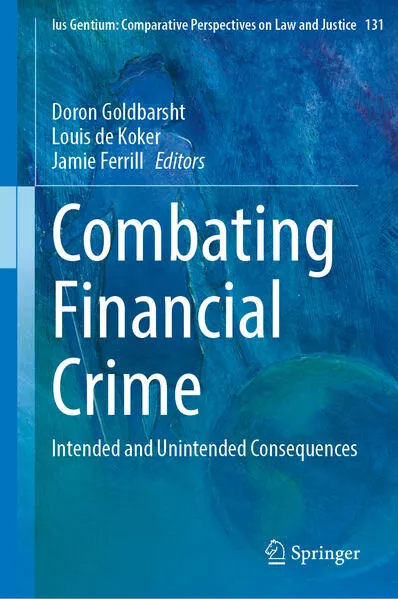
Combating Financial Crime
Intended and Unintended Consequences
This book, a product of the Financial Integrity Hub (FIH), explores the societal costs of combating financial crime and the balance between security imperatives, individual rights, and the integrity of global financial systems. It examines the ethical dilemmas and practical challenges faced by policymakers, practitioners, and the public as they navigate the evolving landscape of anti-money laundering and counter-terrorism financing (AML/CTF) regimes.
While designed to safeguard societies and economies, measures from these regimes can erode privacy, stifle legitimate activity, and exacerbate inequalities. Through analysis and real case studies, this book scrutinises the ethical and legal dilemmas arising from expanded surveillance, showing how the pursuit of security can undermine civil liberties and invite abuse. It assesses the impact of regulatory frameworks on non-profit organisations, vulnerable populations, and businesses, drawing attention to the unintended consequences of well-intentioned policies. It also examines the expanding role of technology in surveillance, raising critical questions about the future of privacy in an increasingly interconnected world. The book highlights the intersection of financial crime and environmental exploitation, demonstrating the far-reaching effects of illicit activity.
Through a global lens, it evaluates regulatory approaches including unexplained wealth orders, risk-based assessments, and emerging tools like Central Bank Digital Currencies. It exposes gaps in current frameworks, questioning whether they adequately address evolving threats of terrorist financing and complex financial crimes. By engaging with these challenges, the book calls for a more nuanced approach to financial crime control, one that protects society without undermining its core values.
Essential reading for legal professionals, policymakers, academics, law enforcement agencies, financial institutions, and anyone concerned with the global fight against financial crime, this book provides critical insights into its ethical and legal dimensions. It encourages reflection on unintended consequences and advocates for a fair, responsible, and balanced approach to safeguarding financial integrity.
Chapter “Surveilling the Citizen: Constitutional Tensions within the Canadian AML Regime” is available open access under a Creative Commons Attribution 4.0 International License via link.springer.com.


Unterstütze den lokalen Buchhandel
Nutze die PLZ-Suche um einen Buchhändler in Deiner Nähe zu finden.
Bestelle dieses Buch im Internet



| Veröffentlichung: | 25.11.2025 |
| Seiten | 332 |
| Art des Mediums | Digital [Kindle] |
| Reihe | Ius Gentium: Comparative Perspectives on Law and Justice |
| Reihe | Law and Criminology (R0) |
| ISBN-13 | 978-3-032-06858-3 |
| ISBN-10 | 3032068584 |

Über den Autor
Doron Goldbarsht, LLB LLM (HUJI) PHD (UNSW), is a Senior Lecturer in Macquarie Law School where he teaches in the field of Banking Law and Financial Crime. He is an authority on anti-money laundering and counter terrorist financing (AML/CTF) regulations, with expertise in the related fields of compliance and financial innovation. Dr Goldbarsht’s recent book, journal and chapter publications focus on different international AML/CTF standards and the mechanisms for their effective implementation and compliance at the national level. Dr Goldbarsht holds a practising certificate from both Australia and Israel. He mentors different start-ups, provides expert opinions in legal proceedings, and is a research fellow with the Optus Macquarie University Cyber Security Hub.
Louis de Koker, LLB LLM (UFS) LLM (Cantab) LLD (UFS) FSALS, is a Professor of Law at La Trobe University, Australia and an Extraordinary Professor at the Faculty of Law of the University of the Western Cape, South Africa. Louis researches anti-money laundering and counter terrorist and proliferation financing regulation, and especially the relationship between financial integrity and financial inclusion policies. He is the RegTech lead of La Trobe LawTech. Louis has worked with the Consultative Group to Assist the Poor, the World Bank, the Alliance for Financial Inclusion and regulators and financial service providers on the design and implementation of appropriate integrity and inclusion measures over the past two decades. His research on integrity laws and their impact on financial inclusion has been cited in publications of international bodies including the World Bank, IMF, the Financial Action Task Force and the Basel Committee on Banking Supervision.
Diesen Artikel teilen
0 Kommentar zu diesem Buch
... weitere Publikationen von Goldbarsht, Doron

.... weitere Publikationen von Springer International Publishing





Formalwissenschaftlicher Beweis der Existenz Gottes über kalkül - Mathematische Philosophie und Philosophie der Grammatik
Bewerbungsfrist bis zum: 29.10.2026