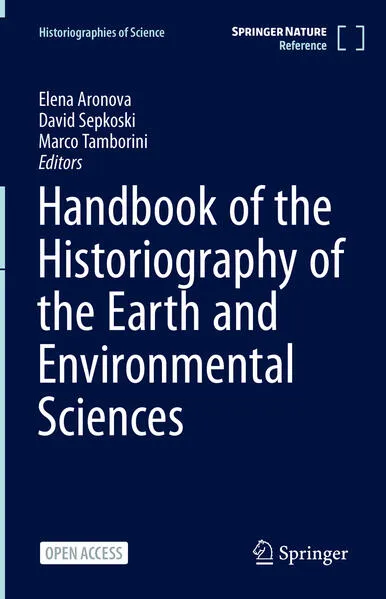
Elena Aronova
Handbook of the Historiography of the Earth and Environmental Sciences
ISBN: 978-3-031-40799-4
521 Seiten | €
Digital [Kindle]
Dieses Buch gehört zur Reihe Religion and Philosophy und enthält ca. 13 Folgen.
Erscheinungsdatum:
28.08.2025
Sonstiges
Elena Aronova
Handbook of the Historiography of the Earth and Environmental Sciences
This open access handbook aims to provide a definitive assessment of the historiography and the future of major themes and approaches within the history of the earth sciences, understood broadly. The volume is intended for a broad range of readers, including graduate students, other scholars, and scientists, both familiar with and new to the history of the earth and environmental sciences.
Essays in the collection reflect on various problems in the study of the history of the earth sciences emphasizing crosscutting themes (such as economics, technology, politics, gender, etc.) and featuring innovative ways of framing historiographic perspectives.
Since scholarship in the history of science is increasingly becoming entangled with environmental, economic and bureaucratic, political, gender, and other historical approaches, the volume as a whole emphasizes the breadth and diversity of scholarship on the earth and environmental sciences.
Essays in the collection reflect on various problems in the study of the history of the earth sciences emphasizing crosscutting themes (such as economics, technology, politics, gender, etc.) and featuring innovative ways of framing historiographic perspectives.
Since scholarship in the history of science is increasingly becoming entangled with environmental, economic and bureaucratic, political, gender, and other historical approaches, the volume as a whole emphasizes the breadth and diversity of scholarship on the earth and environmental sciences.
Unterstütze den lokalen Buchhandel
Nutze die PLZ-Suche um einen Buchhändler in Deiner Nähe zu finden.
Bestelle dieses Buch im Internet


| Veröffentlichung: | 28.08.2025 |
| Seiten | 521 |
| Art des Mediums | Digital [Kindle] |
| Reihe | Religion and Philosophy |
| ISBN-13 | 978-3-031-40799-4 |

Über die Autorin
Elena Aronova is Assistant Professor at the Department of History, the University of California - Santa Barbara. She has published on the history of environmental data collection, history of the International Geophysical Year, history of seismology, and the historiography of science. She is the author of Scientific History: Experiments in History and Politics from the Bolshevik Revolution to the End of the Cold War (University of Chicago Press, 2021), which documents the history of continuous efforts to integrate scientific knowledge and new technologies — from plant genetics to computers — into historical research. She has co-edited two collections of essays: Science Studies during the Cold War and Beyond: Paradigms Defected (Palgrave, 2016) and Data Histories (Osiris 32, 2017).David Sepkoski is the Thomas M. Siebel Chair and Professor of History of Science at the University of Illinois, Urbana-Champaign. He is the author of three books and editor of several volumes, and has published many articles and book chapters on the history of the earth and environmental sciences. His 2012 book Rereading the Fossil Record: The Rise of Paleobiology as an Evolutionary Discipline (University of Chicago Press) documents the development of paleobiology as a hybrid discipline, situated between geology, biology, and data science. His most recent book, Catastrophic Thinking: Extinction and the Value of Diversity from Darwin to the Anthropocene (University of Chicago Press, 2020), examines the history of cultural, political, and scientific extinction debates from the beginnings of paleontology in the early 19th century to the biodiversity crisis and Anthropocene critique of the early 21st.
Marco Tamborini teaches history and philosophy of science at the Technical University of Darmstadt and is member of the Junge Akademie | Mainz -– Academy of Sciences and Literature | Mainz as well as fellow at the Johanna Quandt Young Academy. His search focuses on the history and philosophy of biology, technoscience, and architecture from the 19th century to the present. He has published widely in international journals such as History of Science, Historical Studies in the Natural Sciences, Journal of the History of Biology, Studies in the History and Philosophy of Science, NTM, Studies in the History and Philosophy of Biological and Biomedical Sciences, etc. His current book project, entitled The Architecture of Evolution: The Science of Form in Twentieth-Century Evolutionary Biology (under contract with University of Pittsburgh Press), narrates the neglected contributions of the science of form to the recent development of evolutionary biology—and in particular, to the field of evolutionary developmental biology. Awards: 2017 Everett Mendelsohn Prize, 2020 honorable mention from the Italian Society of the History of Science.
Diesen Artikel teilen
0 Kommentar zu diesem Buch
.... weitere Publikationen von Springer International Publishing




Leserunde
Berlin Summer Love
Bewerbungsfrist bis zum: 12.01.2026