H. Elsässer
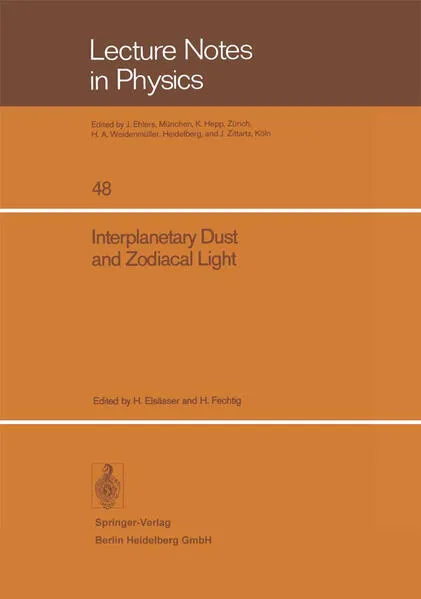
Interplanetary Dust and Zodiacal Light
- Proceedings of the IAU-Colloquium No. 31, Heidelberg, June 10–13, 1975
ISBN: 978-3-540-38133-4
501 Seiten | € 96.29
E-Book [Kindle]
Dieses Buch gehört zur Reihe Physics and Astronomy (R0) und enthält ca. 2 Folgen.
Erscheinungsdatum:
17.09.2005
Sonstiges
H. Elsässer
Interplanetary Dust and Zodiacal Light
Proceedings of the IAU-Colloquium No. 31, Heidelberg, June 10–13, 1975
Inhaltsverzeichnis
- Space observations of the zodiacal light.
- Helios zodiacal light experiment.
- Preliminary results of the helios a zodiacal light experiment.
- Pioneer 10 observations of zodiacal light brightness near the ecliptic: Changes with heliocentric distance.
- Star counts in the background sky observed from pioneer 10.
- The S10 (V) unit of surface brightness.
- Polarization of the zodiacal light: first results from skylab.
- Photometry of the zodiacal light with the balloon — borne telescope thisbe.
- OSO-5 Zodiacal Light Measurements 1969–1975.
- Evidence for scattering particles in meteor streams.
- The ultraviolet scattering efficiency of interplanetary dust grains.
- Summary of observations of the solar corona/inner zodiacal light from Apollo 15, 16, and 17.
- A temporal study of the radiance of the F-corona close to the sun.
- Measurements of the T-corona from daily OSO=7 observations.
- The thermal emission of the dust corona during the eclipse of June 30, 1973.
- The color characteristics of the earth-moon libration clouds.
- A search for forward scattering of sunlight from the lunar libration clouds.
- Presemtation of Zodiacal Light instrument aboard the D2B astronomical satellite.
- Visible and UV photometry of the gegenschein and the milky way.
- Ground-based observations of the zodiacal light.
- Polarimetry of the zodiacal light and milky way from Hawaii.
- Scattering in the earth's atmosphere: Calculations for milky way and zodiacal light as extended sources.
- Scattering layer of cosmic dust in the upper atmosphere.
- Some formulae to interpret zodiacal light photopolarimetric data in the ecliptic from ground or space.
- Discussion of the rocket photometry of the zodiacal light.
- Consequences of the inclination of the zodiacal cloud on the ecliptic.
- Method for the determination ofthe intensity of scattered sunlight per unit-volume of the interplanetary medium.
- On the visibility of the libration clouds.
- Scattering functions of dielectric and absorbing irregular particles.
- The compatibility of recent micrometeoroid flux curves with observations and models of the zodiacal light.
- In-situ records of interplanetary dust particles — methods and results.
- Preliminary results of the micrometeoroid experiment on board helios A.
- Composition of impact-plasma measured by a HELIOS-micrometeoroid-detector.
- Orbital elements of dust particles intercepted by pioneers 8 and 9.
- Flux of hyperbolic meteoroids.
- The cosmic dust environment at earth, jupiter and interplanetary space results FRO, Langley experiments on MTS, Pioneer 10, and Pioneer 11.
- Dust in the outer solar system - review of early results from Pioneers 10 and 11.
- Sources of interplanetary dust: Asteroids.
- Lunar microcraters and interplanetary dust fluxes.
- The size frequency distribution and rate of production of microcraters.
- The long term population of interplanetary micrometeoroids.
- Lunar soil movement registerd by the apollo 17 cosmic dust experiment.
- lectrostatic disruption of lunar dust particles.
- Microcraters produced by oblique incidence of projectiles.
- Measurements of Impact Ejecta Parameters in Crater Simulation Experiments.
- Impact light flash studies: Temperature, Ejecta, Vaporization.
- Submicron Particles from the Sun.
- Analysis of impact craters from the S-149 Skylab experiment.
- Micrometeorite impact craters on Skylab EXPERIMENT S-149.
- Extraterrestrial particles in the stratosphere.
- Magellan collections of large cosmic dust particles.
- Specific sources of extraterrestrial particles.
- Near-earth fragmentation of cosmic dust.
- Dust in comets and interplanetary matter.
- The production rate of dust by comets.
- Can short period comets maintain the zodiacal cloud?.
- Optical properties of cometary dust.
- The dust coma of comets.
- Dust emission from Comet Kohoutek (1973f) at large distances from the sun.
- Predicted favorable visibility conditions for anomalous tails of comets.
- Study of the anti-tail of Comet Kohoutek from an observation on 17 January 1974.
- Condensation processes in high temperature clouds.
- Mariner mission to Encke 1980.
- Meteors and interplanetary dust.
- Meteoroid densities.
- Possible evidence of meteoroid fragmentation in interplanytary space from grouping of particles in meteor streams.
- The heliocentric distribution of the meteor bodies at the vicinity of the earth's orbit.
- Fireballs as an atmospheric source of meteoritic dust.
- Interplanetary dust in the vicinity of the earth.
- Meteor radar rates and the solar cycle.
- Evolution and detectability of interplanetary dust streams.
- On the structure of hyperbolic interplanetary dust streams.
- Expected distribution of some of the orbital elements of interstellar particles in the solar system.
- Sources of interplanetary dust.
- Dynamics of interplanetary duest and related topics.
- Modeling of the orbital evolution of vaporizing dust particles near the sun.
- Orbital evolution of circum-solar dust grains.
- Temperature distribution and lifetime of interplanetary ice grains.
- Radial distribution of meteoric particles in interplanetary space.
- Rotational bursting of interplanetary dust particles.
- Lunar ejecta in heliocentric space.
- Radiation pressure on interplanetary dust particles.
- Are interplanetary grains crystalline?.
- A Technique for measuring the interstellar component of cosmic dust.
- The zodiacal light.
- In situ measurements of dust.
- Can comets be the only source of interplanetary dust?.
- Meteors.
- Final remarks.


Unterstütze den lokalen Buchhandel
Nutze die PLZ-Suche um einen Buchhändler in Deiner Nähe zu finden.
Bestelle dieses Buch im Internet


| Veröffentlichung: | 17.09.2005 |
| Seiten | 501 |
| Art des Mediums | E-Book [Kindle] |
| Preis DE | EUR 96.29 |
| Preis AT | EUR 99.00 |
| Reihe | Physics and Astronomy (R0) 48 |
| ISBN-13 | 978-3-540-38133-4 |
| ISBN-10 | 3540381333 |

Diesen Artikel teilen
0 Kommentar zu diesem Buch
.... weitere Publikationen von Springer Berlin





Leserunde
Formalwissenschaftlicher Beweis der Existenz Gottes über kalkül - Mathematische Philosophie und Philosophie der Grammatik
Bewerbungsfrist bis zum: 29.10.2026