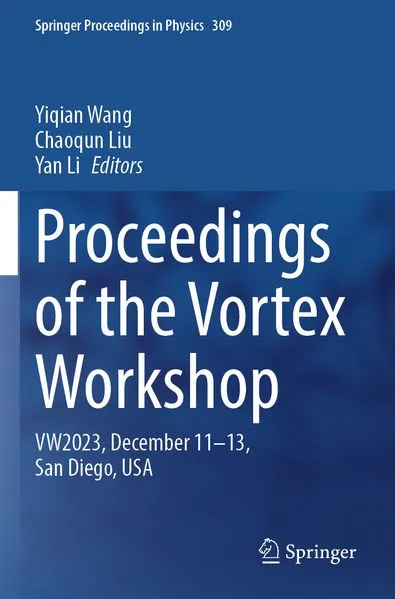
Proceedings of the Vortex Workshop
VW2023, December 11-13, San Diego, USA
Written by the leading experts in the field, this book results from Vortex Workshop 2023 which took place in San Diego, the USA, on December 11–13.
Vortex is ubiquitous in the universe such as tornado, hurricane, airplane tip vortex, and even star vortex in Galaxy. Vortices are also building blocks, muscles, and sinews of turbulent flows. A vortex is intuitively recognized as a rotational/swirling motion of fluids but until recently had no rigidly mathematical definition. In 1858, Helmholtz first defined vortex as composed of so-called vortex filaments, which are infinitesimal vorticity tubes, which is called as the first generation of vortex definition and identification, or G1. Although G1 has been accepted by the fluid dynamics community and almost all textbooks for over a century, we can find many immediate counterexamples, for example, in the laminar boundary layer, where the vorticity (shear) is very large near the wall, but not rotation (no vortex) exists. To solve these contradictions, many vortex criteria methods have been developed during the past 4 decades. More popular methods are represented by the Q, ∆, criteria methods. These methods have achieved part of success in vortex identification, which are called the second generation of vortex identification or G2. However, G2 has several critical drawbacks. First, they are all scalars which have no rotation axis directions, but vortex is a vector. It is hard or impossible to use a scalar to represent a vector. Second, like vorticity, these criteria methods are all contaminated by shear in different degrees. Third, they are all very sensitive on threshold selections. The recently developed Liutex is called the third generation of vortex definition and identification, or G3, which is a uniquely defined vector.


Unterstütze den lokalen Buchhandel
Nutze die PLZ-Suche um einen Buchhändler in Deiner Nähe zu finden.
Bestelle dieses Buch im Internet


| Veröffentlichung: | 16.11.2025 |
| Höhe/Breite/Gewicht | H 23,5 cm / B 15,5 cm / - |
| Seiten | 246 |
| Art des Mediums | Buch |
| Preis DE | EUR 213.99 |
| Preis AT | EUR 219.99 |
| Reihe | Springer Proceedings in Physics |
| ISBN-13 | 978-9-819-78610-7 |

Über den Autor
Dr. Chaoqun Liu is a professor at the School of Mathematics, the University of Texas at Arlington, Texas, the USA.
Dr. Yiqian Wang is an associate professor at the School of Mathematics, Soochow University, China.
Dr. Yan Li is a professor at the School of Engineering, Northeast Agricultural University, China.