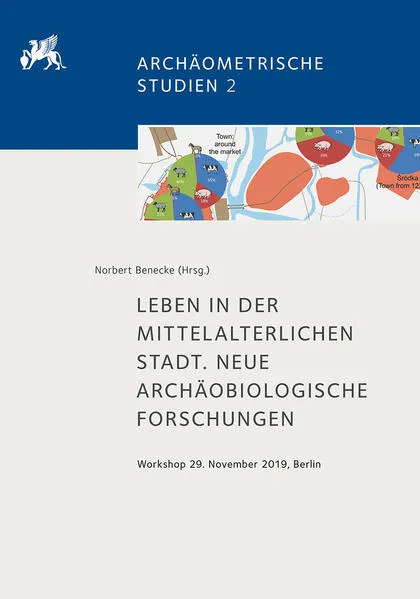
Norbert Benecke
Leben in der mittelalterlichen Stadt. Neue archäobiologische Forschungen
- Workshop 29. November 2019, Berlin
ISBN: 978-3-752-00726-8
260 Seiten | € 98.00
Buch [Taschenbuch]
Erscheinungsdatum:
22.11.2023
Sonstiges
Norbert Benecke
Leben in der mittelalterlichen Stadt. Neue archäobiologische Forschungen
Workshop 29. November 2019, Berlin
Der Band enthält zehn Beiträge eines Workshops vom November 2019, der sich mit dem Leben mittelalterlicher Stadtbevölkerungen aus archäobiologischer Perspektive beschäftigte. Einen Schwerpunkt bilden die Ergebnisse von Untersuchungen an Pflanzen- und Tierresten aus neueren Ausgrabungen in der mittelalterlichen Doppelstadt Berlin-Cölln sowie aus der Altstadt von Köpenick und der benachbarten Burg auf der Schlossinsel. Die behandelten Materialien dokumentieren Besonderheiten und Unterschiede in der Nutzung von Pflanzen und Tieren für die Ernährung in den Wohnquartieren verschiedener sozialer und religiöser Bevölkerungsgruppen sowie im Bereich öffentlicher Gebäude (altes Berliner Rathaus) und auf der Köpenicker Burg. Ähnliche Untersuchungen werden für das mittelalterliche Poznań vor dem Hintergrund der historischen Etappen der Stadtentwicklung sowie für die Fundstelle München-Marienhof vorgelegt. Ein Beitrag befasst sich mit der Versorgung mittelalterlicher und frühneuzeitlicher Städte mit Stockfisch durch die Hanse. Fragen der Umwelt-, Siedlungs- und Wirtschaftsgeschichte des Mittelalters stehen im Mittelpunkt pollenanalytischer Untersuchungen an einem Bohrkern aus der Altstadt von Brandenburg an der Havel. Aspekte der Krankheitsbelastung im Mittelalter werden am Beispiel der Zahngesundheit ländlicher und städtischer Bevölkerungen in Brandenburg thematisiert. Der Band wird abgerundet durch einen methodischen archäozoologischen Exkurs sowie einen Beitrag, der sich mit Problemen und Chancen einer rekonstruierten mittelalterlichen Vergangenheit am Beispiel des Museumsdorfs Düppel in Berlin beschäftigt.


Unterstütze den lokalen Buchhandel
Nutze die PLZ-Suche um einen Buchhändler in Deiner Nähe zu finden.
Bestelle dieses Buch im Internet



| Veröffentlichung: | 22.11.2023 |
| Höhe/Breite/Gewicht | H 29,7 cm / B 21 cm / 1130 g |
| Seiten | 260 |
| Art des Mediums | Buch [Taschenbuch] |
| Preis DE | EUR 98.00 |
| Preis AT | EUR 100.70 |
| Reihe | Archäometrische Studien |
| ISBN-13 | 978-3-752-00726-8 |
| ISBN-10 | 3752007265 |

Über die Autorin
Prof. Dr. Norbert Benecke (Dissertation 1984, Habilitation 1992) ist seit 1979 auf dem Gebiet der Archäozoologie tätig und war von 2003 bis zu seiner Pensionierung 2020 Leiter des Referats Naturwissenschaften am Deutschen Archäologischen Institut. Seine Arbeitsschwerpunkte sind die Nutzung der Tierwelt durch den prähistorischen Menschen in den verschiedenen Landschaftszonen Eurasiens (Neolithikum bis Eisenzeit), Tierdomestikationen sowie Umweltgeschichte Europas (Spätglazial und Holozän).Diesen Artikel teilen
0 Kommentar zu diesem Buch
.... weitere Publikationen von Reichert, L







Leserunde
Formalwissenschaftlicher Beweis der Existenz Gottes über kalkül - Mathematische Philosophie und Philosophie der Grammatik
Bewerbungsfrist bis zum: 29.10.2026